University of Connecticut
I Know This Much Is TrueThe University of Connecticut serves two connected roles in I Know This Much Is True: it is the college where Dominick Birdsey and Thomas Birdsey try, with unequal success, to begin adult lives apart from their family, and it is an institution linked to Wally Lamb’s teaching and the novel’s development. In the twins’ story, the university promises a clean break but cannot by itself undo their dependence on each other. Its dormitories, classes, academic rules, and campus relationships become the setting for that tension.
The twins’ college and the wish for independence
As high school seniors, Dominick Birdsey and Thomas Birdsey were both accepted at the University of Connecticut. Dominick Birdsey had also been accepted at New York University, while Duke University had rejected him; Thomas Birdsey had applied only to the University of Connecticut. Dominick Birdsey imagined making a clean break from the family and from the lifelong pattern of living in Thomas Birdsey’s shadow. He had decent grades and test scores, and work as a swimming instructor at the YMCA had helped him imagine a future in teaching. Thomas Birdsey, who at first did not know what he wanted to do, eventually said that he wanted to teach too.
Money prevented Dominick Birdsey from choosing the more distant possibility of New York University. Instead, he pressed for separate dormitories and roommates at the University of Connecticut, presenting college as the chance for each twin to become an individual. Thomas Birdsey resisted. Their shared ownership of a typewriter became a practical argument against separation: Thomas Birdsey did not want to have to wait for Dominick Birdsey to bring him something he already considered half his. The dispute gives an ordinary object unusual weight. Even as Dominick Birdsey argues for distance, the brothers remain bound by shared possessions and by the expectation that they will continue to be available to one another.
The arrangement did not produce the independence Dominick Birdsey wanted. During their freshman year, the brothers shared a room, and Thomas Birdsey treated Dominick Birdsey’s new friendships as a threat to their closeness. He resented other students knocking at the door, borrowing Dominick Birdsey’s belongings, or inviting him to play basketball. Dominick Birdsey, in turn, wanted the freedom to form relationships without having to manage his brother’s reaction. The dorm therefore functions less as a clean break than as a confined domestic space relocated from home to college.
Academic strain and its consequences
Thomas Birdsey’s college difficulties developed across ordinary features of student life. He complained that the dorm was noisy and too hot, that the atmosphere and professors made studying difficult, and that he could not concentrate. He spent time watching television in the lounge, drinking instant coffee, and staying up late, then slept through morning classes. He resisted making friends and remained dissatisfied with the people around him. The typewriter he had defended so forcefully saw little use, and he rarely opened his books. This decline contrasts with his earlier record: in high school he had worked hard for his grades, even as Dominick Birdsey had earned higher marks with less effort.
At the end of the second semester, the university placed Thomas Birdsey on academic probation. When the brothers returned home after their first year, Ray Birdsey confronted Thomas Birdsey with the tissue-paper grade report, which showed D’s, F’s, and incompletes. The report turned the university’s academic judgment into evidence in a family conflict. Ray Birdsey accused Thomas Birdsey of wasting the money spent on college, while Dominick Birdsey tried to redirect the confrontation toward his own stronger record. He said that his grade-point average was 3.2 and that he had made the dean’s list. The contrast exposed a further imbalance between the twins: both had entered the same institution, but its measures of academic progress recorded sharply different outcomes.
Later, Thomas Birdsey returned to the University of Connecticut and had a new roommate, Randall Deitz. Dominick Birdsey asked Randall Deitz how things were going with his brother and was apprehensive about the answer. At the same time, Thomas Birdsey’s relationship with Angie Constantine intensified. She drove to campus on weekends and stayed overnight when Randall Deitz was away. Her family opposed the relationship: Big Gene Constantine threatened her job as an accountant trainee at the dealership if she did not change her behavior, but Angie Constantine defied him. The university setting thus holds both a renewed attempt at independent intimacy for Thomas Birdsey and Dominick Birdsey’s anxious monitoring of what that intimacy might mean.
The relationship also reached beyond the brothers’ private concerns. Angie Constantine told Dessa Constantine that she and Thomas Birdsey were in love, might become engaged, and might be expecting a child. Dessa Constantine called Dominick Birdsey in tears. After Angie Constantine had left campus, Dominick Birdsey confronted Thomas Birdsey. The news brought the twins’ competing needs into direct contact: Thomas Birdsey was imagining a family life with Angie Constantine, while Dominick Birdsey remained afraid for his brother and reacted as though Thomas Birdsey’s decisions were his to supervise.
Withdrawal and life beyond campus
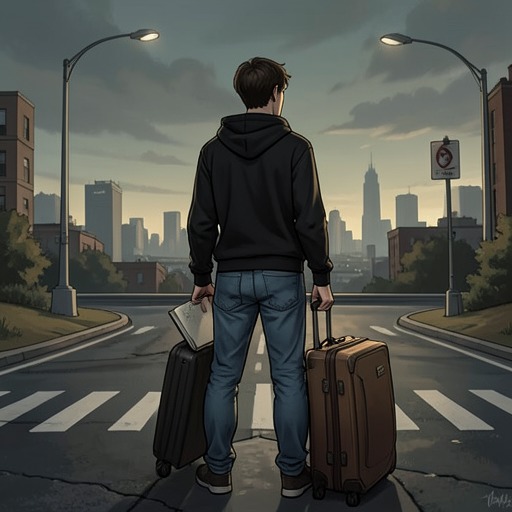
The college’s promise of a reprieve from the Vietnam War became another pressure on Thomas Birdsey. Dominick Birdsey urged him to keep his grades high, arguing that student status could defer military service for three years and that the war might be over by then. Thomas Birdsey responded with familiar complaints about his dorm, concentration, and professors rather than answering directly about his studies. During midyear exams, he withdrew from the University of Connecticut. He packed and returned to Three Rivers without telling Dominick Birdsey first. Dominick Birdsey learned of the decision by telephone and responded with anger, urging his brother to enlist rather than leave college. The withdrawal ended the university’s role as Thomas Birdsey’s immediate route toward education and deferment, while making clear that the brothers’ plans for staying together had not protected either of them from crisis.
After their first year, while home for the summer, both brothers found seasonal work with the Three Rivers Public Works Department. The jobs provided paychecks and kept them out of the house during the day, where Ray Birdsey was at home. Their work was a contrast with the year spent studying and confined together in a dorm room. It also shows how a college calendar could shape their lives beyond the campus: returning home did not restore the previous routine so much as place them in temporary work and another form of shared daily life. Thomas Birdsey’s college record remained a source of family conflict, but the summer employment gave both brothers a practical way to spend the break.
The university beyond the twins’ student years
The University of Connecticut also appears in the novel through sports and later adult relationships. Omar Rodriguez, remembered for a buzzer-beater that won a state high school championship for Three Rivers, went on to play for the university in the mid-1980s. He played there for a couple of years and later spent a season in Europe before leaving the sport. His appearance connects the local memory of a celebrated high school athlete to the university as a larger stage for basketball.
In the later narrative, the university’s women’s basketball program becomes part of Dominick Birdsey and Dessa Constantine’s renewed closeness. Dessa Constantine invited Dominick Birdsey to a game, and he initially approached women’s basketball dismissively. By the end of the season, however, he knew the players’ names and positions and could discuss the strengths and weaknesses of Big East teams. In 1995, he and Dessa Constantine travelled to Minneapolis to watch Rebecca Lobo and her teammates win the national championship. The change is modest but telling: a shared interest develops through time spent together, rather than through Dominick Birdsey’s earlier effort to control Thomas Birdsey’s choices. Later that spring, while walking with Dessa Constantine at Long Nook Beach in Truro, he proposed that they take another chance on their relationship.
The institution has a separate, paratextual connection to the book’s making. Lamb’s author biography identifies him as a teacher at the University of Connecticut. During the National Endowment for the Arts fellowship that began in January 1993, he used the time to write fiction and research in libraries, hospitals, and Native American museums, among other places. He read about identical twins and spoke with families affected by domestic turmoil and mental illness as he prepared to write the novel. The acknowledgments also thank students at the University of Connecticut. These details distinguish the real university associated with Lamb’s work from its fictional role in the twins’ lives, while linking the institution to both the novel’s setting and its creation.
Narrative significance
The University of Connecticut is not depicted through a broad account of campus life or institutional history. Instead, it matters through specific pressures and encounters: applications shaped by cost, a disputed typewriter, a shared dorm room, academic probation, a roommate change, a romance, and a withdrawal during exams. The institution supplies the conditions in which Dominick Birdsey’s desire for separation and Thomas Birdsey’s resistance to it become visible. Its opportunities are real, but they do not guarantee independence or stability; the brothers carry their family patterns into college, and their experiences there in turn become material for conflict at home.
The university’s other appearances widen that function without displacing it. Basketball gives the setting a public and communal dimension, while the authorial material connects it to Lamb’s professional life and research. Across these contexts, the name points both to a place where characters try to make new lives and to a real educational community associated with the novel’s composition. For the twins, college marks an attempted beginning whose limits are exposed by their shared dependence and Thomas Birdsey’s departure. For the book as a whole, the university joins setting, social opportunity, and literary provenance.